

Struggling with missed deadlines, budget overruns, or disorganized workflows? Poor project management can lead to chaos, wasted resources, and frustrated teams. And the good news? With the right approach, you can take control, boost efficiency, and achieve your project goals with confidence.
In this guide, we’ll break down what project management, explore proven methodologies like Agile and Waterfall, walk through essential phases, and highlight the best tools and tips for success. Ready to level up your project management game? Let’s get started!
What Is Project Management?
Imagine trying to build a house without a blueprint, a budget, or a timeline. You’d probably end up with a half-finished mess, wasted materials, and a lot of frustration. That’s exactly what happens when businesses, teams, or individuals try to achieve goals without proper project management.
Project management is the structured process of planning, executing, and overseeing tasks to achieve a specific objective. It’s about turning ideas into reality while ensuring that time, resources, and budgets are used efficiently. Whether you’re launching a new product, organizing an event, or developing software, project management provides a roadmap to success.
At its core, project management consists of three key elements:
- Scope – What needs to be done?
- Time – When does it need to be completed?
- Cost – What resources are required to get it done?
Balancing these 3 factors is what makes project management both an art and a science. A great project manager knows how to keep everything on track while adapting to unexpected challenges.
Why Is Project Management Essential?
You might wonder—why not just dive into a project and figure things out along the way? The answer is simple: without structured project management, things can quickly spiral out of control. Deadlines are missed, budgets get blown, and teams lose focus.
- Keeps Projects on Track: A well-managed project ensures that tasks are completed in a logical sequence, avoiding last-minute rushes or wasted effort. It provides a clear roadmap, so everyone knows what to do and when to do it.
- Maximizes Resource Efficiency: Every project has limited resources—whether it’s time, money, or manpower. Project management helps allocate these resources wisely, preventing overwork, burnout, or unnecessary expenses.
- Improves Team Collaboration: Project management brings structure to teamwork. With clear roles, responsibilities, and communication channels, team members stay aligned, reducing misunderstandings and conflicts.
- Minimizes Risks and Issues: Every project faces challenges—unexpected delays, budget overruns, or scope changes. A good project management approach identifies potential risks early and has strategies in place to tackle them.
- Increases Success Rates: Organizations that invest in project management see higher success rates. According to studies, companies with strong project management practices deliver projects on time, within budget, and with better quality.
Whether you’re leading a small team or handling a large-scale business initiative, effective project management is the key to achieving results without chaos.
Looking for tips and practices to improve your team collaboration? Explore this article: The Ultimate Guide to Fostering Effective Team Collaboration

Types of Project Management
There is no universal project management method that works for every team or industry. The best approach depends on factors like project complexity, timeline, resources, and team collaboration style. Below are 4 widely used project management methodologies, each with its unique strengths, challenges, and ideal applications.
Waterfall Project Management
Waterfall is a linear and structured project management approach. It follows a sequential process where each phase must be completed before moving to the next. Typically, the stages include requirement gathering, planning, execution, testing, and deployment. Once a phase is completed, revisiting or modifying it is difficult without disrupting the entire process.
Key characteristics:
- Projects follow a strict step-by-step process.
- Requirements and goals are clearly defined at the beginning.
- Changes during the project lifecycle are costly and time-consuming.
Best suited for: Traditional industries like construction, manufacturing, and government projects where requirements are fixed and well-documented.
Real-world example: A construction project follows the Waterfall approach. Before building starts, the blueprint, materials, permits, and timeline are finalized. Once construction begins, making major design changes becomes extremely costly and disruptive.
Challenges:
- Limited flexibility; once a phase is complete, changes are difficult.
- Can result in longer project timelines due to rigid structures.
- Not ideal for fast-changing environments.
Agile Project Management
Agile is a flexible, iterative approach to project management. Instead of planning everything upfront, Agile teams divide the project into smaller cycles (called sprints) and continuously adapt based on feedback. The goal is to deliver working results quickly while allowing for changes and improvements along the way.
Key characteristics:
- Projects are divided into short work cycles (sprints).
- Continuous collaboration between team members and stakeholders.
- Changes and feedback are integrated throughout the project lifecycle.
Best suited for: Software development, marketing campaigns, startups, and teams working in dynamic environments.
Real-world example: A software development company uses Agile to build a mobile app. Instead of designing and coding the entire app before testing, the team releases a small functional version first. Based on user feedback, they improve and expand the app in future sprints.
Challenges:
- Requires a high level of communication and collaboration.
- Less predictable timelines and costs due to ongoing changes.
- Needs a strong team culture to ensure smooth implementation.

Inefficiencies and inconsistent results slowing your team down? Exlore Standard Operating Procedures (SOPs): What They Are and Why They Matter? to find out solution.
Lean Project Management
Lean project management is focused on maximizing value while minimizing waste. It originated from Toyota’s manufacturing process, but today, it is used across many industries. The core principle is to remove unnecessary tasks, streamline processes, and optimize workflow efficiency.
Key Characteristics:
- Identifies and eliminates unnecessary steps in a process.
- Emphasizes continuous improvement and efficiency.
- Prioritizes delivering maximum value to the customer.
Best suited for: Manufacturing, logistics, product development, and businesses looking to improve efficiency and eliminate waste.
Real-world example: A manufacturing company adopts Lean principles to reduce waste in production. By analyzing processes, they remove unnecessary steps and optimize supply chain management, leading to lower costs and faster production times.
Challenges:
- Requires a deep understanding of workflows and process optimization.
- Harder to implement in creative projects where flexibility is needed.
- Can be difficult to balance speed with quality.
Kanban Project Management
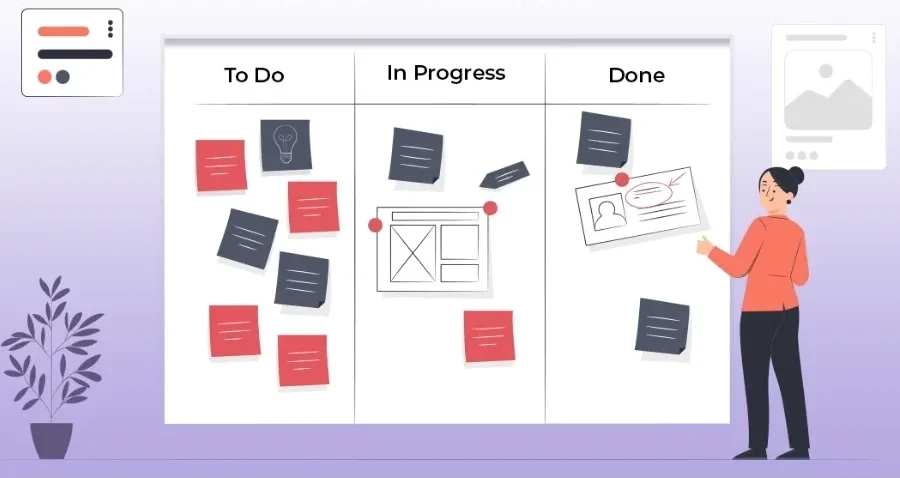
Kanban is a visual project management method that helps teams track tasks and workflow efficiency. It uses boards (physical or digital) to represent different stages of work, such as “To Do,” “In Progress,” and “Done.” This helps teams identify bottlenecks and manage workloads effectively.
Key Characteristics:
- Uses a visual board to track workflow progress.
- Allows teams to continuously update and optimize work processes.
- Ideal for teams handling ongoing or repetitive tasks.
Best suited for: IT support, customer service, marketing, and teams handling ongoing work.
Real-world example: A customer service team uses a Kanban board to manage support tickets. Each ticket moves through different columns based on its status, allowing team members to quickly see which requests need urgent attention.
Challenges:
- Lacks predefined project timelines, making deadlines harder to track.
- Can become overwhelming if too many tasks are in progress.
- Requires regular monitoring to maintain an efficient workflow.
Choosing the Right Approach for Your Project
Each of these project management approaches offers unique advantages, and choosing the right one depends on your project’s needs. In many cases, teams combine different methodologies to create a hybrid approach that fits their workflow best.
For example:
- A software company might use Scrum for development and Kanban for customer support.
- A manufacturing firm could integrate Lean principles into their Waterfall-based production process.
- A marketing team might combine Agile for campaign planning with Kanban for content production.
Ultimately, selecting the right project management structure requires understanding your team’s work style, industry requirements, and the complexity of your project.
Read more: Effective Remote Team Communication: Overcome Distance, Work Smarter
5 Phases of Effective Project Management
Every project, regardless of its industry or complexity, goes through a structured lifecycle to ensure successful completion. These 5 phases, including Initiating, Planning, Executing, Monitoring/Controlling, and Closing, help teams stay organized, meet deadlines, and achieve project goals efficiently.
1. Initiating
The first phase of project management is all about defining the project’s purpose and feasibility. Before any actual work begins, stakeholders need to determine:
- Project objectives: What problem is being solved? What is the expected outcome?
- Scope of work: What are the project boundaries? What is included and excluded?
- Stakeholders: Who are the key players involved (clients, team members, sponsors, etc.)?
- Budget & Resources: What financial, human, and material resources are available?
- Project risks: What potential roadblocks or challenges should be anticipated?
At this stage, teams often use tools like feasibility studies, stakeholder analysis, and a project charter (a formal document that outlines the project’s purpose, goals, and key details).
2. Planning
Once the project is approved, detailed planning takes place. This is one of the most critical phases, as a well-structured plan lays the foundation for smooth execution.
Key activities in the planning phase:
- Defining tasks and deliverables: What specific activities need to be completed?
- Creating a timeline: Establishing deadlines and setting milestones.
- Resource allocation: Assigning tasks to team members based on skills and availability.
- Risk management: Identifying potential obstacles and creating contingency plans.
- Budgeting: Estimating costs and ensuring financial resources are properly distributed.
Popular tools used during this phase include Gantt charts (for scheduling), Work Breakdown Structures (WBS), and project management software to track progress.
3. Executing
The execution phase is where the real work happens. Teams carry out tasks according to the project plan, while managers ensure everything stays on track.
Key elements of project execution:
- Task execution: Team members work on assigned responsibilities.
- Collaboration & communication: Regular meetings, updates, and feedback loops.
- Resource management: Ensuring all materials, finances, and personnel are used effectively.
- Stakeholder engagement: Keeping clients, sponsors, and team members informed.
To keep execution smooth, project managers use collaboration tools like Slack, Microsoft Teams, and task management platforms such as Trello, Asana, or Jira.
4. Monitoring & Controlling
Even with a solid plan in place, projects rarely run without hiccups. The monitoring phase ensures that performance aligns with the plan, and corrective actions are taken if necessary.
Here are key aspects of this phase:
- Tracking progress: Comparing actual performance against planned milestones.
- Identifying risks: Addressing delays, budget overruns, or quality issues early.
- Ensuring quality control: Conducting inspections, testing, and gathering feedback.
- Adjusting strategy: Making changes when needed to improve efficiency.
Project managers use tools like KPI (Key Performance Indicator) dashboards, financial tracking software, and risk assessment frameworks to maintain project health.
5. Closing
Once all project goals are met, the final phase focuses on delivering results and closing out all project activities.
Key activities in the closing phase:
- Final deliverables: Ensuring the product, service, or solution meets all expectations.
- Stakeholder approval: Getting final sign-offs from clients or sponsors.
- Performance evaluation: Reviewing project successes and challenges.
- Documentation & knowledge sharing: Keeping records for future reference.
- Celebration & team recognition: Acknowledging team efforts and lessons learned.
A formal project review often takes place, helping teams reflect on what worked well and what can be improved for future projects.
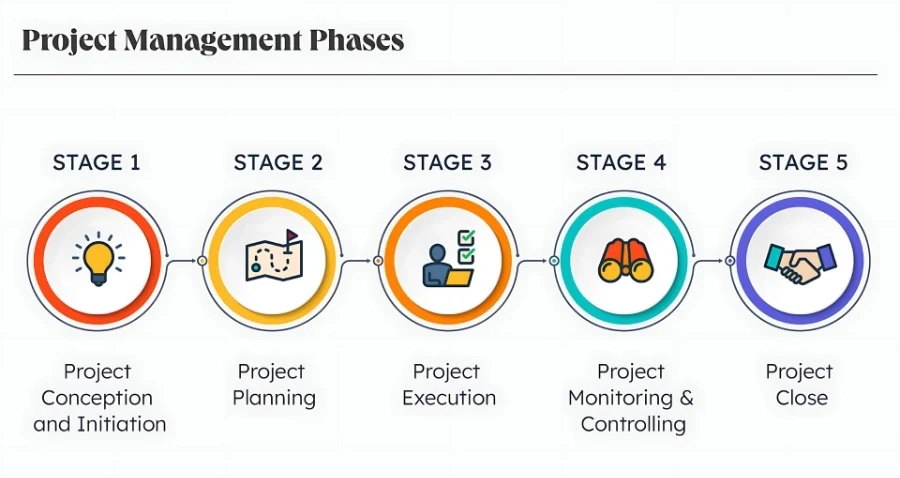
Understanding and following these five project management phases ensures a clear structure and direction for every project. As a result, teams can improve efficiency, minimize risks, and consistently deliver successful projects.
What Tools Are Used in Project Management?
Project management tools help teams stay organized, improve collaboration, and ensure projects run smoothly. Here are some key categories of tools commonly used:
- Task and Project Management Software: Trello, Asana, Jira, Monday.com – helps plan, assign, and track tasks.
- Time Tracking Tools: Toggl Track, Clockify, RescueTime – monitors productivity and optimizes resource use.
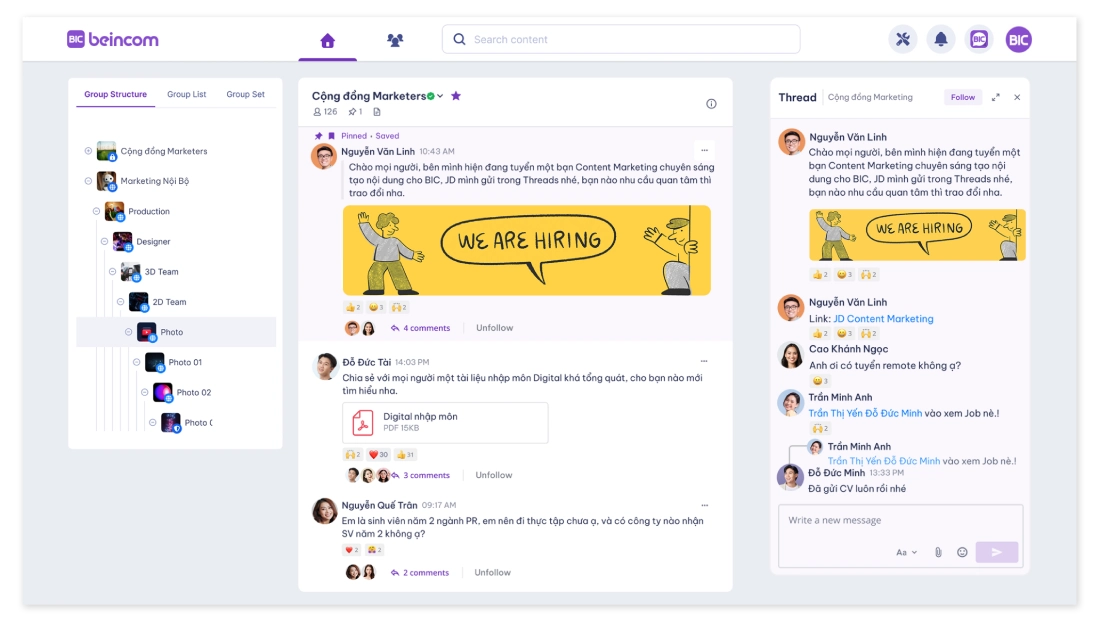
- Collaboration and Communication Tools: Beincom, Slack, Microsoft Teams, Google Workspace, Zoom – facilitates team communication and file sharing.
- Knowledge Management Tools: Beincom, Confluence, Notion, Guru, SharePoint – centralizes project documentation and information.
- File Sharing and Document Management: Google Drive, Dropbox, OneDrive, Box – keeps project files organized and accessible.
- Reporting and Analytics Tools: Power BI, Tableau, Google Data Studio, ClickUp – provides data-driven insights for better decision-making.
- Risk and Issue Tracking Tools: Risk Register, Airtable, Jira – helps teams identify and manage project risks.
Selecting the right combination of tools depends on project complexity, team size, and budget. Using the right tools ensures better productivity, communication, and project success.
Beincom – The Ultimate Collaboration and Knowledge-Sharing Tool
Beincom is a powerful collaboration and knowledge-sharing platform designed to help teams communicate effortlessly and stay organized. Here’s why it stands out:
- Unlimited members – Scale your team without worrying about member or message limits.
- Organized inner groups – Create up to 50 subgroups across 10 levels, keeping conversations structured by department or project.
- Auto-generated chat channels – Every new group automatically gets a dedicated chat space, neatly arranged in an intuitive directory tree.
- Real-time interaction – Communicate instantly with BIC Chat, ensuring seamless teamwork with no delays.
- Simple and intuitive – Easy to use, so everyone can get started right away without a learning curve.
- Threaded conversations – Keep discussions clear and easy to follow.
- Diverse content creation tools – Share information in multiple formats to enhance knowledge exchange.
If you’re looking for an efficient, scalable, and user-friendly solution for collaboration and knowledge sharing, Beincom is the tool for you. Sign up for Beincom today and experience the difference!
7 Practical Tips for Successful Project Management
Even with a structured approach and the best tools, project success depends on execution. Effective project management requires not only careful planning but also the ability to adapt and lead a team toward the project’s goals. Below are essential strategies that ensure projects stay on track and deliver successful results.
Clearly Define Goals and Objectives
Every project should start with a clear vision. Without well-defined goals, teams can easily lose direction, leading to inefficiencies and missed deadlines. Use SMART goals (Specific, Measurable, Achievable, Relevant, and Time-bound) to create actionable objectives.
For example:
- Instead of saying, “Improve website performance,” set a goal like, “Increase website load speed by 30% within 3 months.”
- Instead of “Launch a new marketing campaign,” a better goal would be, “Generate 10,000 new leads through a digital marketing campaign in Q2.”
Setting concrete objectives keeps teams focused and ensures alignment with overall business priorities.
Communicate Effectively and Transparently
Miscommunication is one of the leading causes of project failure. A successful project manager fosters open and transparent communication through:
- Regular status meetings – Weekly or biweekly check-ins keep everyone updated.
- Clear documentation – Meeting notes, progress reports, and task assignments should be accessible to all team members.
- Defined communication channels – Use project management platforms like Slack, Microsoft Teams, or email for different types of discussions.
Encouraging open dialogue helps identify issues early, ensuring that misunderstandings don’t derail progress.
Learn how to improve communication skills in the workplace in: Enhance Your Business Communication Skills: The Key to Internal & External Success
Monitor Progress and Adjust as Needed
A project rarely goes exactly as planned. Successful project managers continuously track progress, adjust strategies, and resolve issues before they escalate.
Key actions to ensure smooth execution:
- Set key performance indicators (KPIs) – Define success metrics (e.g., project completion rate, budget adherence, team efficiency).
- Use dashboards and reports – Real-time analytics provide visibility into project status.
- Identify bottlenecks early – If a task is taking longer than expected, analyze the cause and take corrective action.
By regularly evaluating performance, project managers can make informed decisions to keep everything on track.
Encourage Team Collaboration and Motivation
A motivated and engaged team is essential for project success. Project managers should foster a culture of collaboration by:
- Defining roles and responsibilities clearly – When everyone knows their role, accountability improves.
- Encouraging feedback and idea-sharing – Team members should feel comfortable suggesting improvements.
- Recognizing achievements – Celebrate milestones and individual contributions to keep morale high.
- Providing necessary resources and training – Ensuring team members have the skills and tools they need leads to better results.
A well-supported team is more productive, creative, and motivated to deliver high-quality work.
Explore tool to streamline your team collaboration in: 10 Best Group Chat Apps for Effective Team Collaboration
Manage Risks Proactively
No project is without risks, but effective project management involves identifying and mitigating risks before they become major issues.
Steps to manage risks:
- Identify potential risks – What could go wrong? (e.g., budget overruns, missed deadlines, scope creep)
- Assess impact and likelihood – Prioritize high-risk areas.
- Develop a risk mitigation plan – Create action plans for possible challenges.
- Monitor risks throughout the project – Regularly review risk factors and make adjustments as needed.
A proactive risk management approach prevents unnecessary delays and keeps the project moving forward.
Prioritize Task Management and Avoid Micromanagement
Not all tasks are equally important. Effective project managers know how to prioritize high-impact tasks while avoiding unnecessary micromanagement.
- Use prioritization techniques: The Eisenhower Matrix, MoSCoW method (Must-haves, Should-haves, Could-haves, Won’t-haves), or ABCDE method.
- Delegate effectively: Trust team members to complete their tasks without constant oversight.
- Avoid multitasking: Encouraging a focus-driven work style prevents errors and inefficiencies.
Giving team members ownership over their work enhances efficiency and allows the project manager to focus on strategic decisions.
Read more: Top 10 Effective Knowledge Management Tools to Use in 2025
Conduct Post-Project Reviews and Continuous Improvement
Once a project is completed, it’s essential to analyze what worked well and what could be improved. A structured post-project review ensures that valuable lessons are captured and applied to future projects.
Steps to conduct an effective review:
- Gather feedback – Collect input from team members, stakeholders, and clients.
- Analyze project performance – Compare outcomes against initial goals and KPIs.
- Document best practices and lessons learned – Create a knowledge base for future projects.
- Refine processes – Implement improvements in planning, execution, and communication.
Continuous learning and adaptation lead to better project outcomes over time.

Final Thoughts
Project management is more than just a structured approach to completing tasks—it’s the foundation of successful execution in any organization. Whether managing a small internal project or a large-scale strategic initiative, effective project management ensures that goals are met efficiently, teams stay aligned, and resources are used wisely.
Using the right methodologies and tools for project management is essential yet not enough. Strong leadership, effective communication, risk management, and a commitment to continuous improvement are also critical to project success. Great project managers don’t just oversee tasks—they inspire teams, navigate challenges, and drive results.
Whether you’re new to project management or looking to refine your expertise, applying these principles will help you achieve better outcomes, stay competitive, and drive long-term success.
Beincom


