Communication is something we do every day, often without even thinking about it. We talk to coworkers, send emails, join meetings, text friends, post on social media, and listen to podcasts or presentations.
But communication is not always as simple as sending a message from one person to another.
Sometimes people misunderstand each other. Sometimes a message gets ignored. Sometimes the same message means different things to different people. That is why communication experts created communication models — to better understand how communication works and why it sometimes fails.
Communication models are visual or theoretical frameworks that explain how information moves between people. They show who sends a message, how the message is delivered, who receives it, and what factors can affect the outcome.
Some communication models focus on one-way communication, such as a speech or advertisement. Others focus on two-way communication, where people exchange ideas and feedback. More advanced models show how communication changes over time and becomes more complex as relationships develop.
Understanding communication models can help you become a better communicator in both personal and professional situations. They can also help explain why misunderstandings happen — and what you can do to avoid them.
What Are Communication Models?
Communication models are simplified ways of explaining how communication works. Instead of looking at communication as just “someone talks and someone listens,” these models break the process into smaller parts.
Most communication models include a few basic elements:
- a sender who creates the message
- the message itself
- a channel used to deliver the message
- a receiver who gets the message
- feedback from the receiver
- noise or barriers that interfere with the message
For example, imagine a manager sends an email to the team about a project deadline.
- The manager is the sender
- The email content is the message
- Email is the channel
- The team members are the receivers
- Their replies or questions are feedback
- A confusing subject line or technical issue could be noise
These models help explain why communication sometimes works well — and why it sometimes fails.
For example, if there is no feedback, the sender may not know whether the message was understood. If there is too much noise, the message may be misunderstood or ignored entirely.
Communication models are useful because they make complex interactions easier to understand. They are often used in business, education, media, marketing, customer service, and even personal relationships.
Different communication situations require different models. A presentation, for example, is very different from a group discussion or a conversation between friends. That is why there are several types of communication models, each designed to explain a different kind of interaction.
The 3 Main Types of Communication Models
Most communication models fall into three broad categories:
- linear communication models
- interactive communication models
- transactional communication models
The main difference between them is how they view the flow of communication.
Linear models describe communication as a one-way process. One person sends a message, and another person receives it. There is little or no feedback involved.
Interactive models take things a step further by including feedback. In these models, communication becomes a two-way process where both people respond to each other.
Transactional models are more advanced. They view communication as something that happens continuously, with both people sending and receiving messages at the same time. These models also recognize that communication is affected by emotions, experiences, relationships, and nonverbal signals.
Understanding these three categories makes it easier to see why some models work better for speeches and advertising, while others are more useful for conversations, teamwork, or long-term relationships.

Read more: Strategic Communications: The Complete Guide for Businesses
Linear Models of Communication
Linear models are the simplest type of communication model because they focus on one-way communication.
In a linear model, one person sends a message and another person receives it, but there is no feedback or response included in the process. The communication moves in a straight line from sender to receiver.
These models are most useful in situations where communication is mainly one-directional, such as:
- speeches
- lectures
- advertisements
- radio broadcasts
- television messages
- public announcements
For example, when a company runs an ad on television, the business sends a message to viewers, but viewers do not respond directly during the communication process. In this case, communication flows in only one direction.
Linear communication models are useful because they show the basic structure of communication. They help explain who creates the message, how it is delivered, and who receives it.
However, they also have limitations. In real life, communication is rarely completely one-sided. Most conversations involve questions, reactions, clarification, and feedback. Because of this, linear models are often considered too simple to explain more complex forms of communication.
Still, they remain important because they laid the foundation for many later communication theories.
Aristotle’s Communication Model
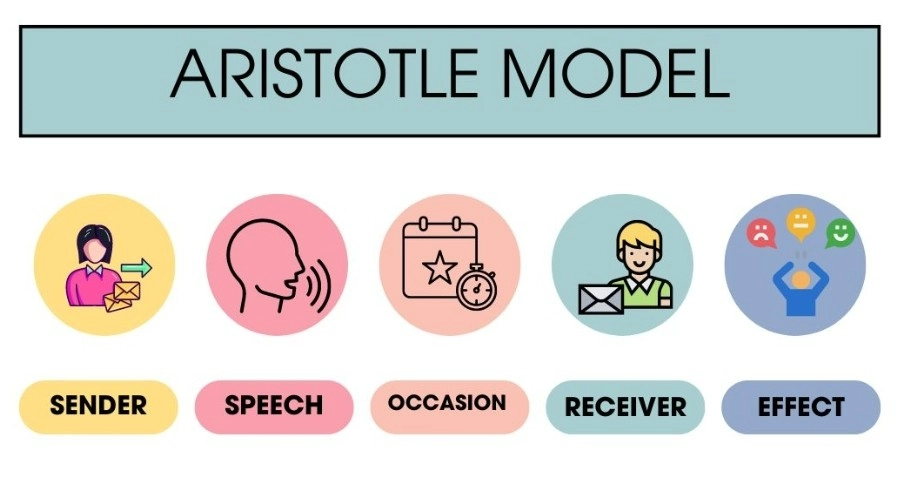
One of the earliest communication models was created by Aristotle. His model was designed to explain public speaking and persuasive communication.
According to this model, communication has five main elements:
- speaker
- speech
- occasion
- audience
- effect
The speaker delivers a message to an audience in a particular situation, with the goal of creating a certain effect.
For example, a political leader giving a speech before an election wants to influence how people think or act. The words, delivery style, and audience all play an important role in whether the message is successful.
This model is still useful today for presentations, public speaking, marketing, and persuasive communication because it focuses heavily on the audience and the desired outcome.
Lasswell’s Communication Model
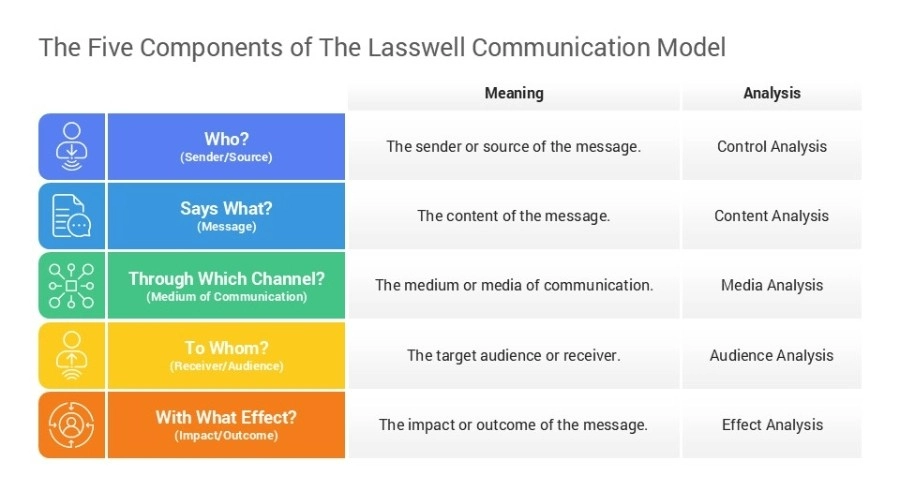
Harold Lasswell created a communication model that explains communication through five simple questions:
- Who?
- Says what?
- In which channel?
- To whom?
- With what effect?
This model is often used in media, journalism, advertising, and mass communication because it helps people analyze how messages are delivered and what impact they have.
For example, if a company launches a social media campaign:
- the company is “who”
- the advertisement is “says what”
- social media is the channel
- customers are the audience
- increased sales or brand awareness is the effect
The model is useful because it encourages people to think not only about the message itself, but also about its purpose and outcome.
The Shannon-Weaver Communication Model
The Claude Shannon and Warren Weaver model is one of the most influential communication models ever created.
Originally developed to improve technical communication systems, it later became widely used in communication studies because it explains how messages can be disrupted.
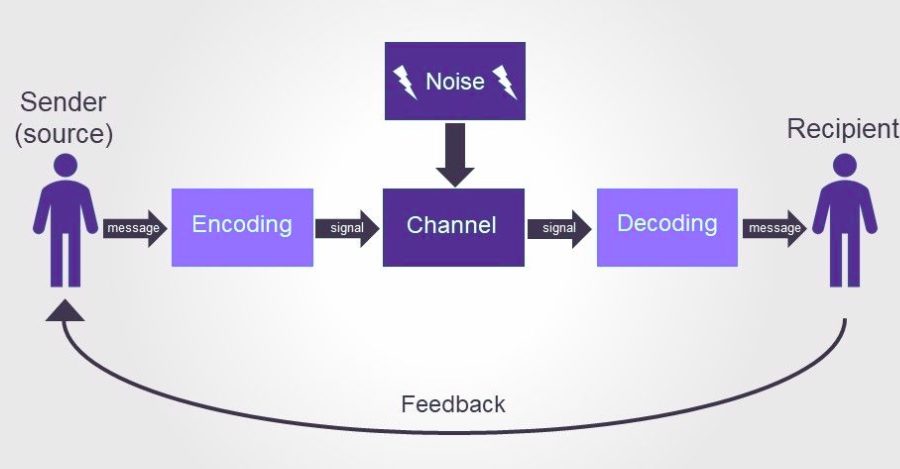
This model includes several key parts:
- sender
- encoder
- channel
- decoder
- receiver
- noise
The sender creates the message, and the encoder turns it into a format that can be transmitted. The message then travels through a channel before being decoded and received by another person.
One of the most important ideas in this model is noise.
Noise refers to anything that interferes with the message and makes communication less effective. It does not always mean actual sound. Noise can include:
- poor internet connection
- background distractions
- language barriers
- unclear wording
- technical problems
- personal bias
For example, imagine a manager gives instructions during a video call, but the audio keeps cutting out. Even if the manager explains everything clearly, the poor connection becomes noise that affects communication.
This model is still widely used today because it helps explain why messages sometimes fail to reach people exactly as intended.
Berlo’s S-M-C-R Communication Model
David Berlo developed the S-M-C-R model to focus more closely on the people involved in communication.
S-M-C-R stands for:
- Source
- Message
- Channel
- Receiver
At first glance, this model looks similar to other linear communication models. However, it pays more attention to the personal characteristics of both the sender and the receiver.
According to this model, communication is influenced by factors such as:
- communication skills
- knowledge
- attitudes
- social background
- culture
For example, two people may receive the same message very differently depending on their experiences or beliefs. A technical explanation that makes sense to an engineer may be confusing to someone without that background.
Berlo’s model also highlights the importance of choosing the right channel. Communication can happen through speaking, writing, hearing, seeing, touching, or other sensory methods.
This model is especially useful when analyzing why some people understand messages differently from others, even when the information is exactly the same.

Interactive Models of Communication
Unlike linear models, interactive communication models recognize that communication is not always one-sided.
In real life, people usually respond to each other. They ask questions, give feedback, clarify ideas, and react emotionally. Because of this, interactive models describe communication as a two-way process rather than a straight line.
These models are especially useful for explaining conversations, interviews, meetings, classroom discussions, and other situations where both people participate.
One of the biggest differences between linear and interactive models is feedback.
In interactive models, the receiver does not simply accept the message. Instead, they respond in some way, and that response becomes part of the communication process.
For example, if a manager gives instructions to an employee, the employee may ask questions, request clarification, or confirm that they understand the task. This feedback helps make communication more accurate and effective.
Interactive models also recognize that communication can be influenced by context, experience, and the environment.
The Osgood-Schramm Communication Model
The Charles Osgood and Wilbur Schramm model views communication as a circular process rather than a one-way event.
In this model, both people act as sender and receiver at the same time.
Instead of having one person speak while the other only listens, both participants constantly exchange messages and feedback. Communication becomes a cycle where each person interprets, responds to, and adjusts based on the other person’s reaction.
For example, during a conversation between coworkers, one person may explain an idea, the other person may respond with a question, and the first person may then clarify their point. This back-and-forth process continues throughout the conversation.
The model also emphasizes that communication depends on interpretation. People do not simply receive information — they interpret it based on their own experiences, emotions, and understanding.
Because of this, the same message can lead to different reactions from different people.
This model is especially useful for explaining interpersonal communication, teamwork, and everyday conversations.

The Westley and Maclean Communication Model
The Bruce Westley and Malcolm MacLean model is more complex because it focuses on how communication works in mass media and news reporting.
According to this model, communication is influenced by both the environment and outside events.
For example, journalists do not create news in isolation. They observe events happening around them, choose which details are important, and then communicate those details to the public.
In this model, messages often pass through intermediaries before reaching the final audience. Editors, reporters, media companies, and social platforms can all shape how information is presented.
This means the final message may not be exactly the same as the original event.
For example, a news story about a company announcement may be interpreted differently by different media outlets. One publication may focus on the financial impact, while another may focus on customer reactions.
This model is particularly useful for understanding media communication, journalism, public relations, and modern digital platforms, where information often passes through multiple layers before reaching people.

Transactional Models of Communication
Transactional communication models take communication one step further.
Instead of showing communication as something that moves back and forth between two people, these models explain communication as a continuous process where both people are sending and receiving messages at the same time.
In real conversations, people do not simply take turns being sender and receiver. They speak, listen, react, interpret body language, notice tone of voice, and respond almost instantly.
Transactional models recognize that communication is shaped by many factors, including personal experiences, emotions, culture, relationships, social context, and nonverbal communication.
These models are especially useful for understanding face-to-face conversations, teamwork, long-term relationships, and situations where communication changes over time.
Barnlund’s Transactional Communication Model
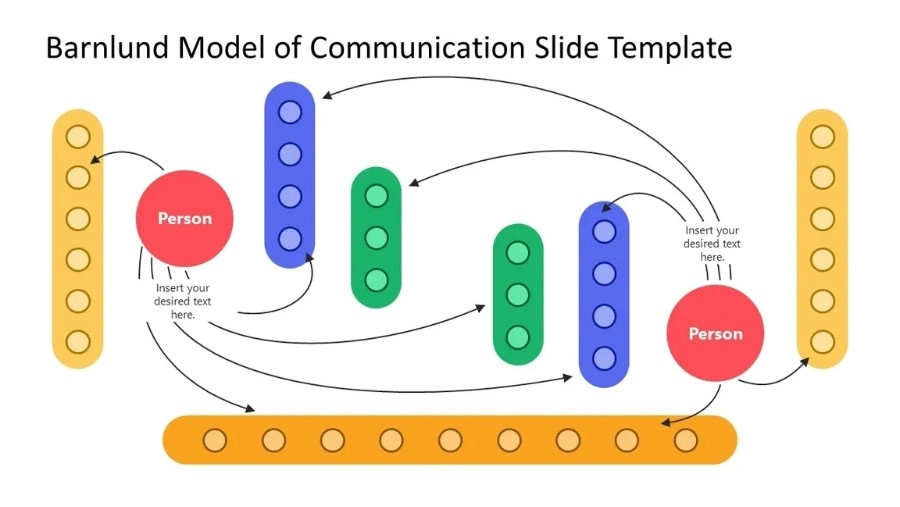
Dean Barnlund created a model that views communication as a complex and constantly changing process.
According to this model, people communicate through different types of cues, not just spoken words.
Barnlund identified three main types of cues:
- public cues
- private cues
- behavioral cues
Public cues are things that both people can observe, such as the environment, location, or objects around them.
Private cues are internal thoughts, emotions, memories, and personal experiences that affect how someone interprets a message.
Behavioral cues include facial expressions, tone of voice, gestures, posture, and body language.
For example, if someone says “I’m fine” while avoiding eye contact and speaking in a frustrated tone, their words and body language send different messages. In this case, the nonverbal cues may reveal more than the spoken words.
Barnlund’s model is useful because it shows that communication is not only about language. It also depends on emotions, context, and nonverbal behavior.
Dance’s Helical Communication Model
Frank Dance developed the Helical model to show that communication changes and grows over time.
He compared communication to a helix, or spiral shape.
The idea behind this model is that communication is never static. Every conversation is influenced by previous experiences, past interactions, and changing relationships.
For example, the way two coworkers communicate on their first day together is very different from the way they communicate after working together for several years.
As people learn more about each other, their communication style changes. They may become more comfortable, more efficient, and better at understanding each other’s behavior.
This model highlights that communication is not limited to a single moment. Instead, it develops continuously as people gain new experiences and build stronger relationships.
Because of this, Dance’s model is especially useful for understanding personal growth, workplace relationships, and long-term communication patterns.